


Financing a Large Scale Home Remodel in Des Moines

Your remodel’s scope can change before you decide how to pay. Financing a large-scale home remodel in Des Moines may involve savings, a home equity loan, a HELOC, cash-out refinancing, or a personal installment loan.
A large renovation can feel more manageable when you know which work matters most and how payment options fit your budget. You can adjust the layout, materials, or project scope before deciding how to finance the work.
Learn how to set priorities, compare borrowing options, and weigh monthly payments against the total amount repaid. You’ll also see how local renovation assistance and a clearly defined project scope can help you plan your next steps.
Table of Contents
How to Finance Your Remodeling Project?
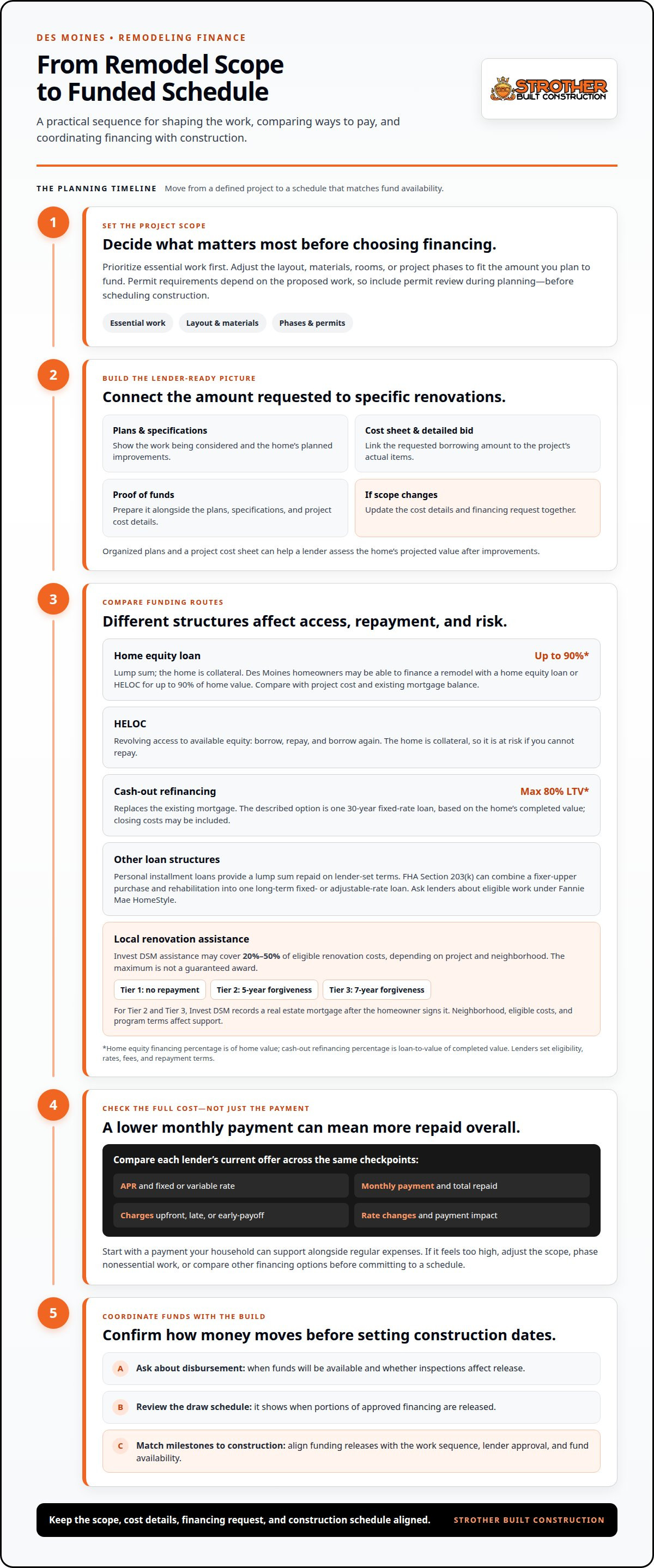
Financing a large-scale home remodel in Des Moines starts with a clear scope and a funding plan that fits it. Compare available home equity, project costs, lender terms, and fund-release timing before setting construction dates.
Financing Based on Renovated Value
Plans, specifications, and a project cost sheet can help a lender request an appraisal based on the home’s completed improvements. The lender sets eligibility, rates, fees, and repayment terms. Des Moines homeowners may be able to finance a remodeling project with a HELOC or home equity loan for up to 90% of their home’s value. Compare that amount with the project cost and existing mortgage balance.
A home equity loan provides a lump sum and uses the home as collateral. A HELOC is revolving, allowing homeowners to borrow, repay, and borrow again. Both put the home at risk if the borrower cannot repay. An FHA Section 203(k) loan can combine a fixer-upper’s purchase and rehabilitation into one long-term fixed- or adjustable-rate loan. Ask lenders about eligible work under Fannie Mae HomeStyle.
Loan and Credit Options
For financing a large-scale home remodel in Des Moines, compare the loan structure as well as the amount. Cash-out refinancing replaces an existing mortgage; the described option has a maximum loan-to-value ratio of 80% of the home’s completed value and is a single 30-year fixed-rate loan. Closing costs may be included. Personal installment loans provide a lump sum repaid over lender-set terms. Credit cards can add borrowing costs.
Medallion Bank is one lender whose written financing terms you can compare. If you want to expand the project, adjust the rooms, materials, or phases before applying. Permit requirements depend on the proposed work, so account for permit review during planning, before scheduling construction.
Funds, Bids, and Contractor Estimates
Prepare proof of funds, plans, specifications, and a project cost sheet for the lender. A detailed bid or contractor estimate connects the amount you want to borrow to the specific renovations. If the scope changes, update the cost details and financing request together.
Ask how funds will be released, whether inspections affect disbursement, and when the money will be available. A draw schedule shows when portions of approved financing are released. Align funding milestones with the construction sequence, then schedule work around lender approval and fund availability.
Renovation support and housing affordability in Des Moines
Des Moines homeowners can explore local renovation assistance alongside mortgage and lending options. Program rules and eligible costs matter as much as the grant amount.
Assistance Amounts and Costs
The program covers between 20% and 50% of eligible renovation costs, depending on the project and neighborhood location. That support can change how much homeowners need to finance through credit, savings, or home equity.
Grant terms differ by tier. Tier 1 grants do not have to be repaid. Tier 2 grants have a five-year forgiveness period, while Tier 3 grants have a seven-year forgiveness period. For Tier 2 and Tier 3 projects, Invest DSM records a real estate mortgage after the homeowner signs it. Include that mortgage obligation when weighing the grant against other financing.
Local Grants and Incentives
Des Moines homeowners researching grants, rebates, or tax incentives can explore Invest DSM’s Homeowner Renovation Program and Neighborhood Finance Corporation support. Available information describes grant and forgivable assistance, but does not establish specific rebates or tax incentives.
Its work supports targeted neighborhood revitalization in Polk County, Iowa. Compare program terms with your mortgage, home equity, and interest rate before deciding how much to borrow.
A proposed renovation might include roofing, siding, gutters, decks, or interior improvements. List each item separately in the project plans so eligible costs can be distinguished from other work. Neighborhood location and project details affect Invest DSM assistance, so don’t treat the maximum grant as a guaranteed award.
Thoughtful plans can also clarify which exterior and interior upgrades belong together. For a coordinated project scope, architectural design services can help shape plans around the work being considered.
Affordable monthly payment options for customers
Look beyond the monthly payment when comparing financing. A lower payment can mean a longer repayment period and a higher total borrowing cost. Compare the APR, whether the rate is fixed or variable, and how a rate change could affect payments. Use the lender’s current offer rather than an old estimate.
Start with the payment your household budget can support alongside regular expenses. Then compare it with the amount you plan to borrow. If the payment feels too high, adjust the scope, phase nonessential work, or review other financing options before committing to a schedule. For example, you could plan new windows separately from other renovations if that better fits your available funds.
Compare each loan’s structure as well as its terms. A personal installment loan provides a lump sum repaid over a set period, with terms determined by the lender. A home equity loan also provides a lump sum, using your home as collateral. A HELOC is revolving, allowing you to borrow against available equity and repay it multiple times during the loan’s life. Consider how each option affects access to funds and repayment.
Compare APRs and identify whether each rate is fixed or variable.
Review the monthly payment alongside the total amount repaid.
Look for upfront charges, late fees, and early-payoff charges.
Ask when approved funds will be available before setting project dates.
Discuss your financing needs with a banker to identify a suitable remodeling loan. Bring the project scope and cost details so the conversation reflects the work you plan to do. Ask how a variable rate could change your payment and compare that possibility with your budget. For a clearer picture of the monthly commitment, ask the lender for a payment breakdown before deciding. A careful comparison can align your repayment plan with the project’s timing and scope.
Home improvement financing for remodeling contractors
Home improvement financing and a construction agreement serve different purposes. Financing approval sets the borrowing terms; project documents describe the improvements being funded. Keep the approved amount, written scope, and payment calendar aligned. If a kitchen remodel expands to include adjoining rooms, update the scope and budget before work proceeds.
Build a clear cost breakdown around the planned construction. Separate major work areas, materials, and allowances so changes are easy to track in the estimate. Then connect expected payments to defined project stages, such as work beginning or a section being completed. The lender controls its own funding process, so plan around approval requirements and fund availability.
For Invest DSM projects, include a 10% contingency reserve for unforeseen project costs in the scope. Keep that reserve distinct from planned improvements, such as replacing siding or renovating an interior. If a change uses contingency funds, document the revised work and cost. This gives the homeowner, construction team, and lender a shared record of what the financing supports.
Before accepting a financing offer, review upfront charges, late fees, and early-payoff charges. Consider these terms alongside the payment schedule, not just the proposed monthly amount. If financing arrives in stages, match each planned payment to the relevant work, and keep invoices, approvals, and completed-work records together. This paper trail helps distinguish costs in the original scope from costs resulting from a change.
For a large home improvement project, start with a defined scope and a funding timeline that supports the construction sequence. Plan your remodeling project around the work you want completed and the financing process you’re using.
Strother Built Construction
Strother Built Construction is a practical next step when you’re shaping renovation plans and weighing how the work fits your budget. Its architectural design services can help develop plans for a coordinated project, while kitchen, bathroom, and basement remodeling can bring those plans to life. A clear scope gives you a more useful basis for discussing project costs and financing with a lender.
When you’re ready to define the spaces, layout changes, and improvements you want, contact Strother Built Construction to discuss your remodel. Share your priorities and plans to start a focused conversation about the project.
Contact Strother Built Construction to discuss your home renovation plans.
Shape Your Remodel Around the Life You Want
Financing a large-scale home remodel in Des Moines is part of a bigger decision: how you want your home to work for you. Before moving ahead, picture the daily routines you want the finished spaces to support. That vision can help keep the project focused as you make decisions and develop plans.
Let your priorities guide decisions about layout, materials, and the work you want completed. A clear direction gives the design and construction process a meaningful starting point, while leaving room to refine details as plans take shape. You don’t need to select every finish before discussing what matters most.
When you’re ready to talk through your renovation plans, contact Strother Built Construction. Take the next step toward a home that feels more suited to the way you live.
Frequently Asked Questions
Can I adjust the scope before deciding how to pay?
Yes. Set priorities first, then revise the planned work before choosing financing. For example, keep essential kitchen layout improvements while postponing decorative updates. Separate must-have work from optional phases so the lender’s requested amount reflects your current plan. If the scope changes after you apply, update the project documents to keep the funding request and construction plan aligned.
How do I apply for financing?
Start with a clear description of the work, its specifications, and an itemized cost sheet. A lender may use these materials to assess the project and request an appraisal based on the home’s completed improvements. Provide any proof of funds the lender requests, then review its approval conditions and funding schedule. Set construction dates around when approved funds will be available.
How should I compare the payments?
Compare each offer by its monthly payment and total repayment, then consider how both fit your household budget. Review the APR, whether the rate is fixed or variable, and how a rate change could affect payments. Include upfront charges, late fees, and early-payoff charges. A payment that seems manageable on its own may not show the full cost of borrowing.
What home renovation financing options are available in Des Moines, Iowa?
Options can include savings, home equity loans, HELOCs, cash-out refinancing, personal installment loans, and FHA Section 203(k) financing for a fixer-upper purchase and rehabilitation. Des Moines homeowners can also explore Invest DSM and Neighborhood Finance Corporation renovation assistance. Strother Built Construction offers homeowner financing options as well. Compare eligibility, repayment structure, and the planned work before choosing a route.
What are current rates and fees for renovation loans in Iowa?
Rates and fees depend on the lender, loan type, eligibility, and repayment terms, so offers may differ. Compare APR, not just the stated interest rate, and determine whether the rate is fixed or variable. Review upfront charges, late fees, and early-payoff charges alongside the total repayment amount. The lender’s current offer shows the terms that apply to your application.
Can an FHA 203(k) or Fannie Mae HomeStyle loan finance a whole-home remodel in Iowa?
An FHA Section 203(k) loan can combine a fixer-upper’s purchase and rehabilitation into one long-term fixed- or adjustable-rate loan. Ask lenders which work is eligible under Fannie Mae HomeStyle; the lender sets eligibility and terms.


Comments