


How to Agree on a Remodel With Your Spouse by Planning as a Team

A remodel works better as a shared plan than a contest over whose taste wins. To decide how to agree on a remodel with your spouse, start with the needs you share, set a firm budget that leaves room for surprises, and agree on who can make which choices. Keep decisions that affect both of you mutual.
It can be harder when one spouse cares less about decorating. That doesn’t mean they have nothing to contribute: they may have clear views on comfort, storage, function, or how the room should feel. Make space for those priorities without involving them in every color and fabric choice.
This guide shows you how to keep design disagreements in perspective, separate needs from nice-to-haves, and make fair compromises. You’ll also learn how to involve a less-interested spouse in a few meaningful decisions, so you can plan as a team and shape a home that works for both of you.
Table of Contents
1. Keeping the relationship in perspective during design disagreements
Before debating tile, paint, or cabinets, agree on the shared goal: a home that works for both of you. Each partner can independently list room needs and wants, then compare the lists without judging preferences. Ask how you want to feel and live at home after the remodel, and where you see yourselves in 10, 20, or 30 years. That conversation can put a disputed finish in perspective.
Divide decisions according to interests and strengths, not assumed roles. One spouse might lead on design, while the other focuses on measurements, function, or budget tracking. For a kitchen, one partner could compare cabinet finishes while the other considers whether the layout supports everyday cooking. Explain the practical reason behind a preference, such as easier storage or a brighter room, instead of treating taste as a contest. Make major design and technical decisions together, then leave smaller agreed-upon choices to each partner.
When you reach an impasse, consider working with an interior designer you both trust. A designer can turn practical and personal priorities into options, explain trade-offs, and suggest a cohesive direction. That gives you a neutral way to compare choices without making a disagreement feel like a test of your relationship. If the conversation gets heated, take a break and return to the specific decision later.
Permits and HOA rules may affect a remodel, depending on the work and local requirements. Before finalizing the plan, ask your local building department about applicable approvals and review your HOA’s governing documents for any design or construction review steps.
Before hiring a remodeling contractor, ask what the project scope includes, how budget changes are handled, how you’ll receive timing updates, and who will communicate decisions. Ask how design and technical questions will be documented, too, so you and your spouse are working from the same plan.
After work begins, pause before changing a shared decision. Compare the concern with the agreed plan, explain what feels wrong, and discuss practical alternatives together. Don’t let schedule pressure or frustration turn a necessary choice into a unilateral decision. If a change affects both of you, agree on the next step before moving forward.
2. Setting a budget with extra funds for the project
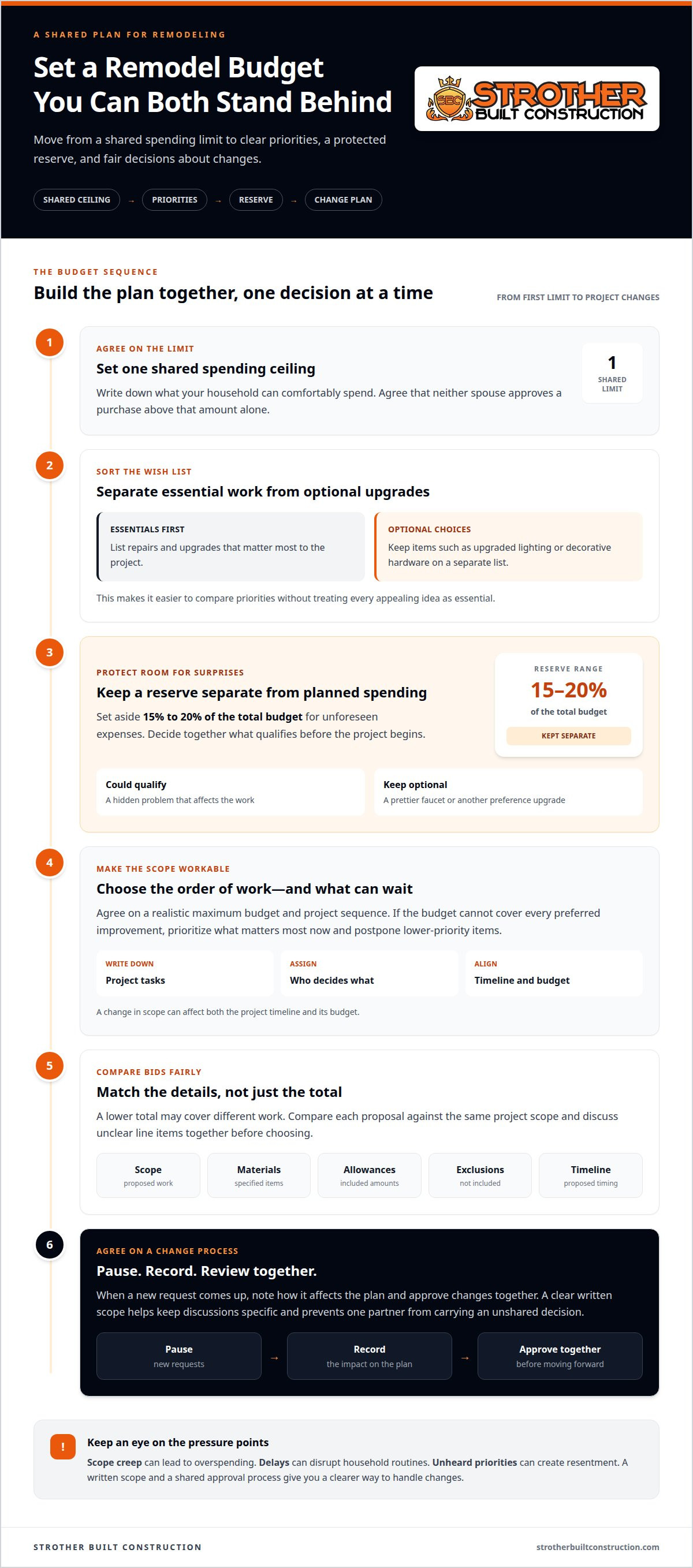
Set a shared spending ceiling before making a wish list. Write down what your household can comfortably spend, then agree that neither spouse will approve purchases above that amount alone. If a kitchen renovation is the priority, list essential repairs and upgrades first. Put optional choices, such as upgraded lighting or decorative hardware, on a separate list. This makes it easier to compare priorities without treating every appealing idea as essential.
Build a reserve into the plan. Homeowners should set aside 15% to 20% of the total budget for unforeseen expenses. Keep that money separate from the amount available for planned finishes, and decide together what qualifies as an unexpected expense. A hidden problem that affects the work may justify using the reserve; a prettier faucet usually belongs on the optional list.
Next, agree on a realistic maximum budget and a project sequence. If you can’t afford every preferred improvement, choose what matters most now and postpone lower-priority items. For example, you might complete a needed kitchen upgrade while delaying a decorative change. Write down the tasks, who is responsible for each decision, and the order of work. Align the timeline with the budget, since a change in scope can affect both.
Compare contractor bids by matching the proposed scope, materials, allowances, exclusions, and timeline. A lower total may cover different work, so compare like with like and discuss unclear line items together before choosing. This helps prevent mismatched expectations.
Common risks include overspending through scope creep, delays that disrupt household routines, and resentment when one partner feels their priorities were ignored. Set a change process: pause new requests, record how each affects the plan, and approve changes together. A clear written scope makes discussions more specific; review your remodeling project plans as you prepare for the next step.
3. Compromising on different tastes
Different opinions don’t mean you can’t work together. Start by collecting favorite room images separately, then look for shared features. You might both prefer natural wood, even if one likes clean lines and the other prefers traditional details. Use that overlap to find a design direction instead of asking either spouse to accept the other’s entire style. A practical way to agree on a remodel with your spouse is to build on the preferences you share.
Make choices in layers. Agree on the room’s overall feel first, then compare colors, materials, and fixtures. If you both like warm neutrals, start there and rule out a color one partner strongly dislikes. For a kitchen, one spouse might prefer dark cabinets while the other wants a lighter room. Consider lighter cabinets with darker hardware, or use the darker finish as a smaller feature. Compare physical samples together, since colors can look different in a room than they do on a screen.
Avoid one-sided compromises on major decisions. Both spouses should agree on changes that affect the room’s function, shared budget, or overall look. Then give each person room to choose smaller details within those boundaries. One partner might pick a preferred light fixture while the other selects cabinet pulls, as long as both fit the agreed plan. Save vetoes for rare, meaningful objections, rather than using them to reject every option you don’t personally favor.
Keep the discussion focused. Bring a short set of options to each conversation instead of overwhelming your spouse with 15 throw-pillow combinations. For each choice, explain what you like and ask what matters most to your partner. A compromise should address both people’s needs, not simply split the difference. If neither option works, pause and find another. This is how to agree on a remodel with your spouse without letting a rushed choice linger in your marriage after the work is done.
4. Respond when a spouse is not interested in decorating
Not caring about decorating doesn’t mean your spouse has no stake in the remodel. They may care more about storage, easy cleaning, or how the room supports daily routines. Ask what would make the space work better, then listen without turning the answer into a style debate. A spouse who dislikes comparing cabinet colors may still know exactly where pots and small appliances should go.
Make the conversation easy to join. Instead of sharing 247 pictures of white kitchens, narrow the choices to a few clear options and explain what decision you need. Ask whether your spouse prefers open shelves or closed cabinets, then discuss the practical difference. A focused question invites a useful answer; a flood of images can make decorating feel like homework.
Give the less-interested partner a meaningful role that suits their strengths. They could measure the room, note daily frustrations, review how a proposed layout affects movement, or flag features that may be hard to maintain. Then agree on which choices need both opinions and which can be handled by the partner who enjoys design. This keeps one spouse involved without requiring equal enthusiasm for every finish.
A quiet response may signal uncertainty, not indifference. Explain the thinking behind a choice, such as selecting a lighter finish to brighten a dim corner, and ask what concerns your spouse. Leave room for an honest answer. If they need time, agree on when to revisit the decision instead of treating silence as approval. A designer can also present a small set of options and help connect visual choices with practical needs.
Need help turning both partners’ priorities into a room plan? Plan your interior design together with support tailored to the space and how you use it.
Strother Built Construction: Kitchen Remodeling
Strother Built Construction can help turn your shared kitchen priorities into a clear remodeling plan. Once you and your spouse agree on the room’s needs, budget, and design direction, Kitchen Remodeling can bring those choices together in a cohesive renovation. If you’re still weighing the layout, finishes, or how the kitchen should work day to day, Architectural Design services can help shape the project around your household’s goals.
The same planning approach can guide Bathroom Remodeling or Basement Remodeling, where practical needs and personal preferences also meet. Bring your priorities and agreed-upon decisions to Strother Built Construction to discuss the next steps for your home.
Contact Strother Built Construction to discuss your remodeling plans.
Take the Next Step Toward a Home You Both Enjoy
Learning how to agree on a remodel with your spouse also means building a shared decision-making process. Before your next design choice, set aside time to talk without rushing. Agree on how you’ll revisit a decision if new information changes your plans, and make room for both partners to say what matters most. That shared approach can make the project feel like part of your life together, not a contest to win.
When you’re ready to turn your ideas into a practical plan, Strother Built Construction can help bring your remodeling vision to life. Start a conversation about the space you want to improve and the priorities you’ve agreed on.
Contact Strother Built Construction to discuss your next steps. A home shaped around both of you is a meaningful place to begin.
Frequently Asked Questions
Why Plan Your Renovation as a Team?
Planning together gives both spouses a voice in choices that shape daily life at home. A useful first step in learning how to agree on a remodel with your spouse is deciding how you’ll handle choices neither of you can make alone. For example, agree to pause and revisit a disputed decision after each person has had time to consider the options.
How should couples discuss goals and priorities for a home remodel?
Choose a calm time to discuss what you want the finished space to help you do. Describe a typical busy morning, evening, or weekend, then name what gets in the way now. One spouse might need a quieter place to work, while the other wants room for guests. Asking each other to explain the reason behind a preference can reveal needs that a design image alone doesn’t show.
How do couples set a realistic remodeling budget together?
Set a comfortable spending limit by reviewing household income, regular bills, savings goals, and other planned expenses. Then decide what you can commit without disrupting those priorities. If you and your spouse view affordability differently, write down the assumptions behind each perspective and compare them. A financial professional can help you understand how the project fits into your broader household plan.
How can couples decide which remodeling projects to do first?
Compare projects by their effect on everyday comfort and how one job may affect another. Improving a cramped entry, for instance, may make daily routines easier, while replacing a decorative feature can wait. Consider whether household needs are changing, such as making a room more useful for a family member. Start with the project that solves the clearest shared problem.
How can couples agree on a remodeling timeline and manage disruption at home?
Before work starts, map out how each stage could affect meals, bathing, sleep, and working from home. If you’re figuring out how to agree on a remodel with your spouse, make a simple backup plan together, such as deciding where to prepare basic meals if the kitchen is unavailable. Set a regular time to review progress and adjust household routines if the work sequence changes.

Comments